TED talk

Do you know what it feels like to not have feeling in your arms? Well if we’re being general then no, but there are millions of people that do and by using technology we can help get them back to having feeling again. Hello my name is Chris Johnson and I am a sophomore from Ilead academy. The question I started with has true meaning to a subject that I have deeply looked into. For around 50,000 people each year they lose a limb to amputation which can be either an arm or a leg or both. To help solve their disability issue prosthetist design and fit prosthetics to the patient specifically. In recent years though prosthetist along with engineers have been implementing robotics into their prosthetics so that they have movement. With these new robotic limbs the patients have full range of motion,but they still don’t have any feeling in them. My Idea implements a Brain computer interface system connected to a sensory overlay within the limb that allows for data that shows temperature and texture. As I was researching all of this I realised that the system that I wanted to design can use the brain’s natural electrical signals, It uses a technology that we know how to use, and will have a lasting impact on lots of people.

The system I want to design and implement uses current technologie that we have. The BCI or brain computer interface is an implant that allows for the user to send signals from the brain directly to a computer. I want to take one of these and redesign it to allow the system to send data from a computer back to the brain for processing. Rightnow the current system only allows for signals to be sent form the brain to a computer. My redesign uses an antomus program set at the end of the system’s original program that tells it to run in reverse using the data that the sensors have collected in a matter of seconds. This is where things get interesting since the brain has its own way of creating and sending signals we would haft to defy logic and allow a computer to have direct entry to your brains operations. You see that brain uses its neurons to send neurotransmitters to the synapses where it binds to receptors where ions are released to create electricity sending a signal to the appropriate nerve. For my system to work we would have the system send its signals to a neuron to automatically release the right neurotransmitters to the receptor to convey the correct felling.

Not only will we have an advantage of being able to use technologies that we have previously used,but we will also be using science that we know very well. As I have said before the system uses the natural neurons in the brain to manipulate it into giving the correct signals to the correct nerve. So we know about ow that part of the machine will work. We also, know how muscles contract and that is the other part of the machine with the robot parts on the new limb that the person will receive apun being accepted into the program that will be developed in order to roll out the new idea to hospitals worldwide. The Last part of the project releases on psychology you see in order for someone to use this machine correctly they will need to go to phonological therapy to train their brain to work efficiently with the machine so, that no errors occur.
How to Change It

Last time I wrote on this discussion we were talking about how the brain communicates with your muscles. If you don’t remember or are just joining us for the first time then hers a link to the first part of this discussion [post link here]

Now then if your all caught up then we can start with today’s topic which is how we can change the brains behaviors so that it can allow for BCI interaction on a new level. Currently, BCI’s only allow for the brain to send data to the computer however the goal of my project is to allow the brain to also, receive data so that it can process it into feeling.

Going off of what we learned last week we know that it is the receptors that process the commands that are given to your body. So, in that case we will need to take the current BCi systems and outfit them with a feedback system


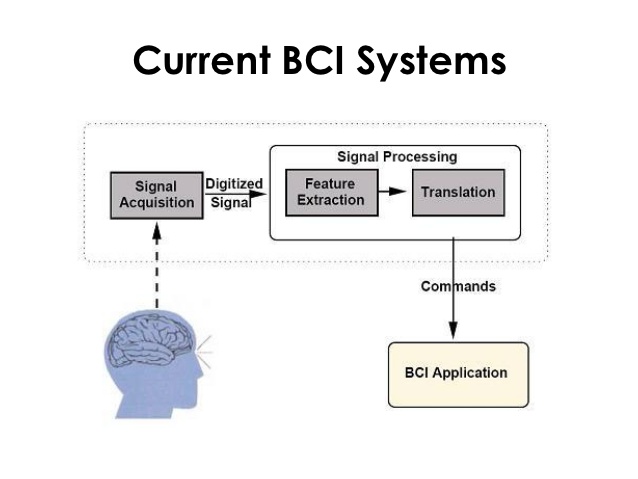
The image above shows the way that current BCI systems work. First, it acquires the signal by scanning the part of your brain. next, it takes the signal and turns it into digital code where it can process it and give it life in the program. lastly, the BCI system uses the extracted code to perform the action that the person was thinking of. This is great for running a computer, but we still are running into the problem of no feeling. That’s where the feedback loop comes in. if we can have the system take data who says that we can’t have them do that function but in reverse.

This process would haft to be carefully deliberated because one wrong code and the program could fry a person’s brain. However, if we can make this work we could attack prognostics with temperature sensors and a sensor that detects textures. With these, we could then tell the BCI systems to run backward sending the data that the sensors get to the brain.

That’s all for this week come back next time where ill go more in-depth with how the new system will work.

What’s it’s function

Last time I mentioned that I would be talking about how the brain works well to make it less broad i’ll simplify that idea into today’s topic witch is how the brain tells muscles to work. To start let’s go over few vocabulary words.

  1. Neuron-
    a specialized cell transmitting nerve impulses; a nerve cell.
  2. synapse-
    a junction between two nerve cells, consisting of a minute gap across which impulses pass by diffusion of a neurotransmitter.
  3. neurotransmitters-
    a chemical substance that is released at the end of a nerve fiber by the arrival of a nerve impulse and, by diffusing across the synapse or junction, causes the transfer of the impulse to another nerve fiber, a muscle fiber, or some other structure.

Pay attention to these three words because they will be used throughout today’s topic.Now then with those words in mind lets start with the first point of today’s idea of how muscles communicate with the brain. The first, part of this process stars in the brain at the sensory and control cortex’s where your brain tells the body what it’s feeling and how to move. when you go to move say your arm or leg the neurons in the brain send neurotransmitters to synapses where they the are bonded to the receptors of the cell membrane of another neuron. there are different types of neurotransmitters for different functions of you’r body two common ones are serotonin and dopamine. The next step of the process takes place after the neurotransmitters have boded to another cell the receptor of the receiving cell will open up to allow ions or atoms with more or less electrons to enter the cell. Then positively charged ions will enter the cell causing electricity to be made the allowing the signal to be sent to where it needs to go. and that is how the brain communicates with muscles.

tune in next time for the next topic of discussion.

The Journey Begins

Hello and welcome to my blog of discovery. Here I will be discussing my passion project for my 2018-2019 English class. Right now you’r probably thinking what’s a passion project well it’s simple. A passion project is something that a person decides that they want to learn more about and they design a project based around it.

The purpose of my project is to show people that by using the brains normal functions we can create prognostics that have feeling. The idea came to me from one of my favorite animated shows that I watch. I this program they use a headset that utilizes the brain to allow the people to play in a video game where they can feel everything. This led me to think how I could apply that concept to real life and so my passion project was born. I deiced that there was one thing that this could really benefit and that is amputees. why you ask, well that is because when your limb is removed there is a possibility that the nerves are still alive and that they still work. However, since they can’t just attach a new arm to a person they give them a prognostic.

A prosthetic is a fake body part that looks life like and serves the same function as the real thing. In recent years however they have started to incorporate robotic elements to the prognostics so that they move more easily,but there’s still no feeling. My solution to this problem is to take a modern day BCI or Brian computer interface and revise it so that it will allow the robots to send data back to the brain that control sensory data. I still have lot’s of research to do so i’d better get back to it check in next time to learn more about the brains functionality.